A Piano Man Is Born

In 1973, Billy Joel released his breakthrough album, Piano Man, which contained the hit single and title track, “Piano Man.” It eventually hit as high as #25 on the Billboard Hot 100 chart, and it’s still one of the best known rock songs of all time.
The song immediately conjurs up images of the stereotypical piano player/lounge singer, performing in a bar full of lonely people looking for a few songs to cheer them up. But what made it appeal to so many people, even to this day?

How “Piano Man” Struck A Universal Chord

I believe several factors contributed to the longevity and popularity of the song.
First of all, the melody is very simple, which makes the song very singable. In fact, it’s so simple that without someone to sing the lyrics, it almost sounds like a child could have written it. But there’s more to the melody than that – it kind of sounds like on old German drinking song, don't you think? It doesn’t even need lyrics – part of the song is just, “La da da di dee da…” But when you add in, “Sing us a song, you’re the piano man…,” I don’t know about you, but it makes me want to gather ‘round the piano, raise a mug of beer, put my arm around the guy next to me, and just sing along. Now that's a song that's going to last forever!
Then there are the Piano Man lyrics. Again, there’s nothing magical about them, is there? The whole song is just one big description of a particular setting – there’s no big story, no development, just a description of the bar, the people, and the piano. The lyrics are so well done, can’t you just feel yourself sitting in that bar, listening to the piano, and “sharing a drink they call loneliness”?
Finally, I think there’s something even bigger than the melody and the lyrics – it’s a kind of coming together, or sharing in the human experience through this song. I don’t want to get too “out there” with this, but be honest – don’t you feel some sort of connection with the people in the song – who, by the way, are fictional versions of actual people – and even a connection with people who simply know the song? Sure, there are other songs that do that, too, but “Piano Man” does it through the piano, in a way that pays tribute to the instrument, the musician, and the listeners. And as a piano lover, that certainly puts the song at the top of my list, and - I'm guessing - probably yours, too, if you’re even just half the fan of the piano that I am. Heck, I think there's a time when "we're all in the mood for a melody."

Piano Man Lyrics

Here are the original Piano Man lyrics. Sit back, sing out, and enjoy!
Piano Man
Words and Music by Billy Joel
It's nine o'clock on a Saturday
The regular crowd shuffles in
There's an old man sitting next to me
Making love to his tonic and gin
He says, "Son can you play me a memory
I'm not really sure how it goes
But it's sad and it's sweet
And I knew it completevWhen I wore a younger man's clothes"
Sing us a song you're the piano man
Sing us a song tonight
Well we're all in the mood for a melody
And you've got us feeling alright
Now John at the bar is a friend of mine
He gets me my drinks for free
And he's quick with a joke or to light up your smoke
But there's someplace that he'd rather be
He says, "Bill, I believe this is killing me"
As a smile ran away from his face
"Well, I'm sure that I could be a movie star
If I could get out of this place"
Now Paul is a real estate novelist
Who never had time for a wife
And he's talking with Davy, who's still in the Navy
And probably will be for life
And the waitress is practicing politics
As the businessmen slowly get stoned
Yes they're sharing a drink they call loneliness
But it's better than drinking alone
Sing us a song you're the piano man
Sing us a song tonight
Well we're all in the mood for a melody
And you've got us feeling alright
It's a pretty good crowd for a Saturday
And the manager gives me a smile
'Cause he knows that it's me they've been coming to see
To forget about life for a while
And the piano sounds like a carnival
And the microphone smells like a beer
And they sit at the bar and put bread in my jar
And say "Man what are you doing here?"
Sing us a song you're the piano man
Sing us a song tonight
Well we're all in the mood for a melody
And you've got us feeling alright

The History Of The Piano


I really wish I could tell you that the history of the piano involved the workshop of some brilliant musical instrument inventor, months of trial and error, hundreds of prototypes, sleepless nights, and a final flash of inspiration. Yes, that would be a pretty cool story, but it wouldn’t be true.In reality, the organ, clavichord, and harpsichord were around for quite a while before the piano was invented – about 300-400 years. In fact, the piano wasn’t that big of a stretch from the harpsichord and clavichord, but something about the richness and sustainability of its sound helped it stand on its own almost immediately.
The organ, also a keyboard instrument, makes sound when air is blown across pipes of different sizes, just like the sound you get when you blow across a soda bottle – notice how the sound changes with the size of the bottle and the amount of liquid in it.
The harpsichord and clavichord are both string instruments, like the piano. In a harpsichord, a little “plectrum” plucks different strings to sound different notes. In a clavichord, the string is struck by a small metal “tangent” (kind of like a flat-head screwdriver) that not only creates the sound, but controls its pitch, based on where the tangent hits the string.

So How Is The Piano Different?

In 1700, Bartolomeo Cristofori di Francesco had the idea of striking the strings with a hammer, which produced a much more pronounced and sustained sound. This was the birth of the piano as we know it.
Soon after Cristofori’s invention, the piano “action” was developed, which not only kept the strings damped when not being played, but also kept the hammers from remaining on the strings after striking them.

The Journey To The Modern Piano

Since we promised this would be a brief history of the piano, let's take a quick stroll through the next 300 years...
In the early 1700's, Gottfried Silbermann invented the precursor to the modern damper pedal, which lifts the dampers from all the strings at once. Viennese pianos of the 18th century - often referred to as fortepianos - incorporated wood frames, two strings per note, and used leather-covered hammers. This gave them a softer, clearer sound than today's pianos, but with less sustain.
From the late 1700's to the late 1800's, iron frames came into use (allowing up to 3 strings per note), as did steel piano wire "strings." Felt hammers began to replace the earlier leather-covered versions in 1826, damper and sostenuto pedals were perfected, and the keyboard grew from 5 octaves to the modern 7 1/2 octaves (or more).
There really weren’t a lot of major changes in the piano over the last 200+ years, which goes to show you that the piano may have been one of those instruments that was just destined to be created! Aren’t you glad it was?

Different Types Of Pianos For Different Needs


The development of different types of pianos came about from the different demands and needs of both professional and amateur musicians alike. The piano is a large instrument, so transportation – and/or availability of a suitable instrument – is a key concern of professionals. Likewise, the space required for a piano can be a concern for musicians looking to enjoy a piano in their own home.
Many musicians don’t need or want an actual, acoustic piano and instead make use of electronic keyboards, electric pianos, or even digital pianos, which today produce sounds virtually indistinguishable from an actual piano.

General Categories Of Pianos

Before getting into specific types of pianos, it’s important to understand some general piano categories:
  • Acoustic Piano – This is the general name for the standard, non-digital, non-electronic piano. Sound is created when keys activate hammers that strike tuned metal “strings” inside a sounding cabinet.
  • Electric Piano – This is not the same as an electronic piano. An electric piano is basically an acoustic piano with “pickups” on the strings that allow the sound to be amplified electrically. It’s actually an electro-mechanical device, combining the action of a traditional piano with electrical amplification.
  • Electronic Piano – This is not the same as an electric piano. An electronic piano simulates piano sounds using analog circuitry, similar to the way electronic synthesizers work.
  • Digital Piano – This type of piano also uses electronic circuitry to produce piano sounds. However, the sounds in a digital piano are usually “samples” – digital representations – of actual piano sounds recorded – or sampled – from actual pianos. They are usually much cheaper, lighter, and smaller than acoustic, and even electric pianos.
  • MIDI Piano – MIDI stands for “Musical Instrument Digital Interface” and therefore seems like it would only be applicable to digital pianos, but any type of piano above can have a MIDI implementation. MIDI allows computers and other instruments to communicate with each other by sending digital “messages” back and forth over various communication channels. These messages include information concerning specific notes played, duration, volume, etc. All that’s needed to implement MIDI is an interface system that can communicate with the instrument. There are even acoustic, player pianos that record songs and can communicate with other instruments via MIDI.

What Is a Piano Chart?


Beginning students use piano charts to help them gain familiarization with the instrument.
The piano is often considered one of the most effective instruments for teaching and learning music theory. This is because the piano encompasses both the treble and bass clefs and is laid out in such a way that it's easy to visualize the concept of scales and chord structure. Many piano teachers use charts to help their students become more familiar with the piano and the notes associated with it, making it even easier to teach the instrument.

  1. Piano Key Chart

    • Piano teacher use a piano key chart to teach the notes on the piano. Some of these charts are pocket sized and can be carried around for easy reference, but some teachers recommend full size charts that run the length of the piano and sit above the keys in the exact place where the note falls on the piano. This way, beginning students have an easy way to see the notes they play until they know where the notes are automatically.

    Piano Scale Chart

    • A piano scale chart shows musical scales and the position of the notes of those scales on the piano. This chart usually has the scales presented visually, as they would be written on sheet music and as they appear on the piano keys. This is a helpful tool for teaching students to sight read because it visually enhances the relationship between the notes on the music staff and the notes on the keyboard itself.

    Piano Note Chart

    • A piano note chart is a simple chart that shows the full range of the piano. It does not break the notes down into key signatures. Instead, the notes are arranged on the music staff and encompass both the bass and the treble notes of the piano. Some of these charts will include an image of the keyboard itself, with a line going from the notes on the staff to the appropriate key on the keyboard.

    Piano Chord Chart

    • A piano chord chart shows students how to construct chords on the piano. The notes for each chord will be displayed on the music staff. Over each chord is a graphic showing how to place your fingers on the piano keys to make the indicated chord.

    Piano Sheet Music

    • Piano sheet music is called a piano chart. This is a piece of music arranged for the piano. A piano chart will incorporate the melody and the bass line of a song into a condensed piano version. The bass line is worked into the left hand part of the song and the melody and other instrument parts are condensed to the right hand part. Piano sheet music can also be referred to as piano/vocal and may even include chord symbols for the guitar.


Looking For Piano Chords?

Well, look no further. Here you'll find a chart of piano chords. A chart can be really helpful when you're someone who likes to play chords.
On this page, the piano chord charts list chords according to their starting note. All C’s are together and so on. You can also find specific pages on major chords, minor chords, and diminished chords. You’ll find a chart of those specific piano chords plus learn how to make them.
Chords starting with: C  C#  Db  D  Eb  E  F  F#  G  A  Ab  Bb  B

Chart of Piano Chords - C and C#: 


Key: C
C = C E G
Cm = C Eb G
C7 = C E G Bb
CM7 = C E G B
Cm7 = C Eb G Bb
Csus = C F G
Csus7 = C F G Bb
C6 = C E G A
C2 = C D E G
Key: C#
C#= C# E# G#
C#m = C# E G#
C#7 = C# E# G# B
C#M7 = C# E# G# B#
C#m7 = C# E G# B
C#sus = C#F#G#
C#sus7 = C# F# G# B
C#6 = C# E# G# A#
C#2 = C# D# E# G#
Chart of Piano Chords - Db and D:
Key: Db
Db: Db F Ab
Dbm: Db Fb Ab 
Db7: Db F Ab Cb
DbM7: Db F Ab C
Dbm7: Db Fb Ab Cb
Dbsus: Db Gb Ab
Dbsus7: Db Gb Ab Cb
Db6: Db F Ab Bb
Db2: Db Eb F Ab
Key: D
D: D F# A
Dm: D F A
D7 : D F# A C
DM7: D F# A C#
Dm7: D F A C
Dsus: D G A
Dsus7: D G A C
D6: D F# A B 
D2: D E F# A
Chart of Piano Chords - Eb and E:
Key: Eb
Eb = Eb G Bb
Ebm = Eb Gb Bb
Eb7 = Eb G Bb Db
EbM7 = Eb G Bb D
Ebm7 = Eb Gb Bb Db
Ebsus = Eb Ab Bb
Ebsus7 = Eb Ab Bb Db
Eb6 = Eb G Bb C
Eb2 = Eb F G Bb
Key: E
E = E G# B
Em = E G B 
E7 = E G# B D
EM7 = E G# B D#
Em7 = E G B D 
Esus = E A B
Esus7 = E A B D
E6 = E G# B C#
E2 = E F# G# B

Chart of Piano Chords - F and F#:

Key: F F = F A C
Fm = F Ab C
F7 = F A C Eb
FM7 = F A C E
Fm7 = F Ab C Eb
Fsus = F Bb C
Fsus7 = F Bb C Eb
F6 = F A C D
F2 = F G A C
Key: F#
F# = F# A# C#
F#m = F# A C#
F#7 = F# A# C# E
F#M7 = F# A# C# E#
F#m7 = F# A C# E
F#sus = F# B C#
F#sus7 = F# B C# E
F#6 = F# A# C# D#
F#2 = F# G# A# C#
Chart of Piano Chords - G, Ab and A:
Key: G
G = G B D
Gm = G Bb D
G7 = G B D F
GM7 = G B D F#
Gm7 = G Bb D F
Gsus = G C D
Gsus7 = G C D F 
G6 = G B D E
G2 = G A B D
Key: Ab
Ab = Ab C Eb
Abm = Ab Cb Eb
Ab7 = Ab C Eb Gb
AbM7 = Ab C Eb G
Abm7 = Ab Cb Eb Gb
Absus = Ab Db Eb
Absus7 = Ab Db Eb Gb
Ab6 = Ab C Eb F
Ab2 = Ab Bb C Eb
Key: A
A = A C# E
Am = A C E
A7 = A C# E G
AM7 = A C# E G#
Am7 = A C E G
Asus = A D E 
Asus7 = A D E G
A6 = A C# E F#
A2 = A B C# E

Chart of Piano Chords - Bb and B:

Key: Bb
Bb = Bb D F
Bbm = Bb Db F
Bb7 = Bb D F Ab
BbM7 = Bb D F A
Bbm7 = Bb Db F Ab
Bbsus = Bb Eb F
Bbsus7 = Bb Eb F Ab
Bb6 = Bb D F G
Bb2 = Bb C D F
Key: B
B = B D# F#
Bm = B D F#
B7 = B D# F# A
BM7 = B D# F# A#
Bm7 = B D F# A
Bsus = B E F#
Bsus7 = B E F# A
B6 = B D# F# G#
B2 = B C# D# F#

A chart of piano chords can be a great reference for you. If you find that you don’t want to always be looking up a chord, check out piano chords diagrams. It gives you a basic formula for learning many of the different kinds of chords.

... have fun playing them!

Piano Chords Diagrams


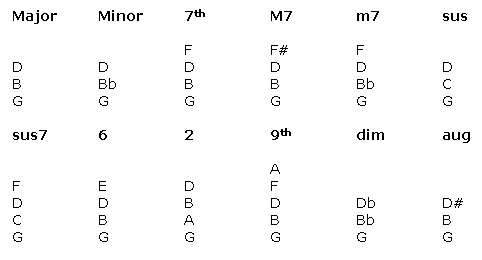
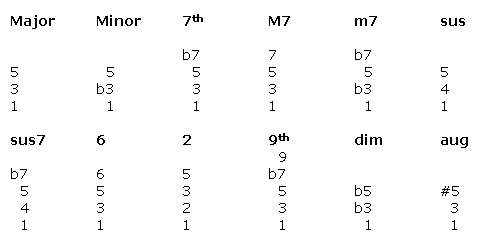
Piano chords diagrams show you what notes of a scale to play together to make a chord. I always start by thinking about the major chord and then change things from there.
If you would like a list of what notes to play for all of the different chords, go to piano chord charts.
The piano chord diagrams are used to show how to make different types of chords. When you start from a major chord , keep in mind the key signature of that major chord. The key signature will tell you which notes to play and how to lower or raise notes for the other
chords.

Note that “b” means to lower the note by one semi-tone. “#” means to raise the note by one semi-tone.
Piano chords diagrams:

Piano Chords Diagram


Here’s an example of what to do with the chord diagrams. We’ll use the key of G. It has one sharp – an F#. The notes of the scale are GABCDEF#. G is 1, F# is 7.

Piano chord diagram in G Major


Piano chord diagrams are basically a formula for finding chords. You can always look up a specific chord you need to know in the chord charts. But if you know key signatures and the chord diagrams, you can make any chord right on the spot!

Piano Playing Secrets of a Chord Addict!


I wish you could have seen me play the piano when I was just learning. I was the nearest thing to "hopeless" that you could imagine. I was into baseball, not music - and my heroes were Joe DiMaggio, Mickey Mantle, and Ted Williams. (And by the way, I still have a picture of those 3 guys on my wall.) My dream was to hit baseballs like them, not to play the piano.
But an opportunity to play with a combo presented itself to me when I was a freshman in high school. Seems the piano player of the group had graduated the previous year, and nobody else played piano well enough to play in the school jazz combo. I didn't know zilch about playing in a group, and I didn't know chords. But I was excited to have the opportunity to play with older guys, and so I took the job.
The lead sax player told me I really should know chords in order to play in the group, so I searched through a music magazine until I found an ad for a chord chart. It cost two bucks, as I recall, so I sent off for it. When I received it in the mail I slipped it behind the keys on my parents old upright piano, and promptly learned to play my first chord - Dm7. I LOVED the sound of it, and was hooked for life on chords. The 2nd chord I learned was Cmaj7, then Em7, then Ebm7 - and before that first night was over I had learned to play "Frankie & Johnnie" - the tune in my right hand, and those fabulous 7th chords in my left hand!
I loved it - LOVED IT - LOVED IT! And it even sounded good enough to impress some of my friends the next day. I suppose that simple chord chart that cost me two bucks has been worth several million over the course of my lifetime. And much more than that, has been worth quadrillions in pleasure and satisfaction and relaxation and......
Even though I came in the back door as far as piano playing was concerned, I learned fast because of what I knew about chords, so college was a snap, and so was my post-graduate Masters Degree at Southern Oregon University. After high school I studied with several of the finest private teachers on the West Coast, including a year with THE finest teacher - his name was Dave - and his studio was on Cauhenga Blvd. in Hollywood. As I would come for my piano lesson, I would often pass a big name recording artist coming to their lesson - and anyone who was anyone in Hollywood in those days took lessons from Dave.
Dave taught me 2 fundamental principles about piano playing:
1. The piano is NOT played with the hands - it is played with the brain. The hands are just tools.
2. If you master chord relationships, you can master music.
I've got little fat hands with short fingers. Hardly the ideal hands for piano playing.
I've also got a lousy sense of rhythm.
But you know what? Because of those two principles Dave taught me, I can play "above" my fat hands and my weak rhythm.
Above?
Yes.
Above.
Once a person "gets into the flow" of understanding chord relationships and then letting the brain knowledge flow into the hands, that person plays "above" his ability.
And the great thing about it is this: It's not some secret formula hidden in the archives of some dusty music conservatory in Prague. Instead it's an open book - there are courses galore on the internet you can take for peanuts compared to a traditional music conservatory. The internet age has provided a way for the average person to become an above-average musician!Learn it here.

10 Reasons Why Your Fingers Need To Go To Boot Camp!


Reason 1: Go from not knowing which finger to use to feeling confident in any fingering situation!
You know the feeling of being tangled up? Like your being twisted into positions you aren't comfortable with? I know you know what I am talking about, well, the Finger Twisters category is the category that will teach you how to instantly know which fingers to use and when!
Reason 2: Go from constantly losing the beat to keeping the beat, without missing a beat!
One of the major reasons of feeling clumsy on the piano is not being able to keep the beat while trying to remember everything else you have to do. The Rhythm Buster category will give you focused, repetitive drills to help you finally get over the hump of keeping a steady beat without missing a beat!
Reason 3: Turn your "weaker" fingers into fine tuned muscles to banish the disobedient-finger syndrome.
The Finger Fitness category will help you overcome having fingers that don't want to obey because they have a mind of their own. You know, when you try to play the ring finger and your pinky wants to play with it? This is due to muscle weakness in those fingers. The exercises in the Finger Fitness Category will strengthen each finger evenly so you can play smoothly without interuption of lazy, disobedient fingers.
Reason 4: Go from feeling lost when you leave your 5 finger comfort zone to feeling right at home anywhere you go on the piano.
Do you get lost on the piano and forget where you are when you are asked to leave your comfort zone? The exercises in the Reach and Stretch category will give you exactly what you need to feel confident with all the keys on the piano so that you never feel lost.
Reason 5: Not using scales? Find out why scales will help you overcome feeling comfortable with any new song you are learning no matter how difficult.
If scales were a 4 letter word, it would be the "bad" word in playing piano. However, if used properly, you can learn a lot with just scales alone. Even if you didn't have all these other categories, playing scales will improve your playing skills almost over-night!
Reason 6: Finally fix the "Left Hand Not Knowing What the Right Hand is Doing" Syndrome
Does your left hand know what your right hand is doing? Do they want to try to copy each other and play the same fingers at the same time? This category, Hand Control, will get rid of the urge to want to play the same things with both hands. These exercises will teach each hand and finger to be independent of each other.
Reason 7: Go from slow and agonizing chord switching to a smooth switch every time without missing a beat!
Chord-ination is a category that you can't do without! You can't play piano without playing chords, and chords seem to be an annoying little challenge that seems to slow down your songs and cause long pauses. Find out how to make smooth changes and stop those long pauses forever.
Reason 8: Looking at the keys too much? Balance the art of using eyes, ears and finger-distance memorization.
Looking at the piano is not a bad thing, but it is when you are dependent upon it and you forget what you are doing when you look away. With these exercises, you will overcome this dependency.
Reason 9: Go from left hand confusion to confidence through intimate knowledge of the lower half of the piano.
There is more than one way to play a C chord, or any other chord for that matter! These step by step instructions will show you how to play "inversions" of chords. This knowledge will eliminate left hand confusion and increase instant recognition of keys on the lower half of the piano.
Reason 10: Meet the Metronome Maestro! If the metronome isn't your friend, here's how to get acquainted!
Do you have trouble keeping on the exact beat with an outside source such as a metronome, counting out loud, with someone singing, or with another instrument? These exercises will keep you on beat as you develop precise rhythm skills using a variety of different rhythm
keepers.

You've probably already invested your time and possibly even some money into learning the piano...right? Isn't time to make your investment count by making sure your playing skills are the best they can be?You can learn it here.

Learning To Play Piano - Common Beginners' Problems

Beginners face a steep learning curve when introduced to the piano. The piano needs to be understood, as does the music that will be read and played on the piano.

There are a number of common problems that all beginners tend to experience that are at first seen as insurmountable. Obviously they are not, but they do need strategies that will overcome the issues, and allow the student to move on with their learning of both the instrument, and the music to be played on it.

The first issue that students face is trying to run before they have learned to walk. Learning the basics of music is essential. The basics consist of little more than the names of the notes and the values of each of the note types. The complicated parts of music will be learned progressively. Failing to learn these fundamentals will slow down the student's progress dramatically. The names of the notes follow the alphabet from A through to G. This is not a lot to learn. The note values relate to the time the note is played for. Slow and careful repetition of learning where the notes fit on the music, and where they relate to the keys of the piano will launch the student into their studies. Learning music is similar to learning a new language albeit in the form of a code but with far less words to remember. As with learning a language. Music needs to be learned slowly at first.

The second issue, again, involves attempting to do too much to soon. As a piece of music is learned it should be broken down into a few bars at a time. A few bars should be learned well then a few extra bars added until the whole piece is understood.

A similar issue is one of learning to play with both hands at the same time. Students find this aspect much easier than they at first thought they would. Just as in the previous issue breaking the music into a few bars at a time is the way forward. Learning one hand at a time before putting them together is the solution.

A second issue occurs with using both hands. Students look at the left hand to see where it is. Unfortunately they also need to be looking at the right hand at the same time, as that hand has to play its notes at the same time as the left hand plays its notes. Repetitive practice of pieces of music in time overcomes this issue.

Following the music presents its own problems. At first students need to look at their hands to ensure that they are playing the correct notes. This requires them to take their eyes off the music to look at their hands. On returning to the music they have lost their place. As with other issues, slowing down the pace of the piece, to a speed that allows the student to follow the music and deal with each hands position on the keyboard, will allow the correct notes to be played with the correct timings without the place in the music being lost.

As is obvious all of the above issues are overcome using one solution. Slowing down the pace of progression to one that is manageable. To put it in other words; not running before one can walk.

Developing The Skill To Play Piano By Ear

     Many beginning pianists struggle with their lessons, simply because they do not yet have the ear for it. This means that technique is that much more important. You can make your lessons much easier if you learn to play piano by ear.
Learn To Develop An Ear For Piano
Playing piano by ear is an effective way to simplify your lessons. It can be a difficult skill to learn. However, you have been learning new things every day, and this should be no different. Life is full of learning experiences, so there is no reason for you to stop now.
Piano songs are usually classified by grade. For example, to be able to play piano songs that are graded five through eight, you will need to have seven or eight years of playing experience. Obviously, this means that learning to play the piano can't happen over night. If you come across a claim online that a service can teach you to play the piano in less than a week, it is just not true. This is an impossibility, because learning the piano takes a great deal of practice, dedication, and patience.
The good thing is that there is something that can accelerate your learning, and that is learning piano by ear. This method has been proven time and again by some of the best pianists in the world. Once you have developed this skill, you can play almost any song that you hear.
Many people think that playing by ear is only an advanced technique. The truth is that, while this skill does help advanced pianists, it is a skill that can, and will benefit the beginner, as well. As a matter of fact, this is the best time to learn, and this skill will only get stronger as your playing matures.
Private instruction can cost you a great deal of money, especially when you add the cost of music sheets. When you learn how to play piano by ear, you can save yourself these added expenses. If you are serious about playing the piano, you can learn to play by ear.
When you play the piano, you must be able to memorize your lessons. You must also have the heart and dedication to your music. Without these two factors, you will not be able to express the music that you play effectively. Dedication is especially important, because you will need to practice regularly, even when you don't want to, to become the best you can. It will take years of practice to play with heart and grace.
To all you beginning pianists, start learning to play piano by ear. It is something that every ambitious pianist should know to continue molding their craft. If you want to move on to the next level, playing by ear is essential. Find the best learning method, whether it is your private instructor, video lessons, books, or online.

Developing Your Piano Skills

     In choosing what instrument you should learn to play, the piano is should certainly be foremost among those you are considering, as it is one of the most flexible of the musical instruments that we have today.
Playing the piano is widely acknowledged as one of the most popular and absorbing hobbies that you can really enjoy. Whatever your favorite genre of music is, once you learn and get serious about piano, you can surely apply your skills and enjoy playing music in that particular genre.

First Steps For Beginners
When you first take up piano, it can often be difficult to know where to start. The first thing that you must do is to actually choose the piano instrument that you'll use. Of course, buying a piano can often be a big commitment, especially if you're planning to buy it from new, so most people will usually begin with a second

hand piano, or a keyboard.
The keyboard will usually be the best option if you're not sure about whether you will be entirely committed to the piano, since it is also significantly cheaper that other bigger and grander pianos.
The next step to start piano is to choose how you plan to learn. Majority of people will arrange a series of lessons with a tutor or an experienced piano player. But you will also find comprehensive online piano lessons which are recommended in such cases where scheduling lessons with tutors is likely to be difficult due to lifestyle or time constraints.

Lessons Online Or In Person?
There are benefits to both types of lessons, and ultimately both will end up with you playing piano. But how fast you learn, your lifestyle, and the amount of time you can dedicate to your lessons in piano are the factors that will determine how well you will learn playing piano, and which between those types of lessons will work better for you.
If you've decided to take lessons in person, you'll usually need to find a good tutor that will be able to guide you through the exercises and the playing styles which you will use to develop to an intermediate level of playing piano.
The other option of course, is to buy a course of piano lessons online. There are also a number of benefits when choosing this method to begin playing piano. Firstly, online lessons tend to be significantly cheaper than having a real-life teacher. Secondly, this method will really suit you if you cannot commit to regular appointments for your lessons, or you want to learn in your own time and pace.

Conclusion
Playing piano is indeed one of the best hobbies that you can start if you are looking for an interesting and satisfying hobby.
While at first, the playing piano can be quite frustrating, if you dedicate some time to complete the right exercises and practices, you will really have great fun and more importantly, a skill which will impress your friends and family.
Whether you choose to learn by yourself using a series of online lessons or hire a tutor to guide you through the early steps in playing piano, all your efforts will be repaid by the advances in your skills. Moreover, you can also start playing the music that you have wanted to play all along.

Best Age To Start Piano Lesson.

     Around the age of 5, children gain the ability to recognize symbols and use "props" in their everyday play; a stick as a sword, a broom as a horse, a hand as a pistol, etc. This development is an important first step as musical notation is a series of symbols that need to be translated to different movements and placement of the fingers.
This ability to recognize symbols also go hand in hand with a child's language development. At this age, children are starting to translate their verbal language ability to writing and reading; perfect time to simultaneously introduce the language of musical notations. Their mastery of the alphabet is also essential to the learning of the musical alphabet--the first seven letters of the alphabet.
Along with their language development, children at this age also gain the ability to understand concepts like "before", "after", or "above" and "below". This development allows children to read musical notations going up and down on the page and translate that into movements to the right and left of the piano. Reading music this way is paramount in developing a pianist's reading ability because it takes away the step of recognizing notes as alphabets and then translating to movements, directly into translating movements on the page into movements of the fingers.
At 5 years old, the majority of children also start entering into the school system for the first time. The transition into more time away from parents and more time outside of the home helps ease a child into piano lessons with a private teacher. Their activities at school hones a child's ability to follow directions and rules, these are all very important abilities in having productive and effective lessons. Their entrance into the school system also helps a child become more comfortable around other adults and authority figures besides their parents.
Lastly, children around this age start to gain better control of their body. Kids at this age can start to participate in various sports. It's common for kids to start joining sports teams like baseball, soccer, flag football, or to start swimming competitively. This development of the larger movements then progresses to development of fine motor skills. Following their want for more independence at this age, a child starts to want to tie their own shoelaces, or button their own shirts--all activities that require fine motor control. This development provides a fine gateway into piano learning, another activity requiring fine motor control.

You Prefer Piano Or Keeyboard?

    Which is better.. Keyboard or Piano? Real pianos are great but the one big drawback is you can’t turn the volume down so with a piano you tend to end up playing for the neighbors. With a keyboard you can stick on some headphones and play whatever turns you on – you can experiment, make mistakes and sound silly and play something a thousand times without driving other people nuts. Ideally – have BOTH! If you are buying a piano it is preferable to buy an overstrung piano not a straight strung! How to tell: Lift the top lid of the piano you should see the tuning pins at the top of the piano. If the tuning pins are evenly spaced along the pin block and the strings are all parallel and vertical this is a straight strung piano. If there is a group of tuning pins at the left and a separate group at the right and the strings cross over in a X shape this is an overstrung piano. Also get a tuner to check it out. I bought a piano once that needed to have the wood treated because all the pins (that tighten the strings) were coming loose very quickly after being tuned – disaster! What Keyboard should you choose? A lot depends on what you want. Do you want a keyboard that sounds and feels like a Piano – then you’re looking for a keyboard or Digital Piano with WEIGHTED keys. Listen carefully to the piano sound – don’t be bamboozled by all the other buttons. If you want something portable then you are looking for a keyboard. Personally I would still look for one with weighted keys – I hate the feel of light plastic keys. Get a keyboard with at least 61 keys – anything less and you will be craving for more keys after a few days. Also make sure get a sustain pedal, a keyboard is absolutely a dead thing without one. Without a sustain pedal as soon as you lift your finger off a key the sound stops dead – with a piano at least the strings vibrate for a second or two – the difference is quite noticeable.

It's Fun To Learn Piano

    Most people don’t really want to ‘learn’ to play the piano or ‘practice’ the piano, they just want to ‘play’ piano. ‘Play’ sounds like fun, ‘practice’ sounds like a chore. We get this image from childhood – some kid stuck indoors ‘practicing’ scales while all the other kids are outside the window ‘playing’. So, first thing we need to do is to see our piano practice in a new light. See it as a way of accelerating the learning process so that SOON you’ll be able to ‘play’ piano and play it well. If you don’t practice and you just play old familiar tunes you move rather slowly. Yes, you’ll get better at playing those old familiar tunes but technically you won’t be pushing yourself to greater heights. Proper, structured piano practice helps you stride forwards. I say ‘proper’ because a lot of people have an idea that practice IS just playing songs over and over. Practice needs to involve uncharted territory. The golden rule is – ‘practice what you CAN’T play, not what you CAN play’. First of all, work out what you want to achieve. Do you just want to know all your chords without thinking about how they are formed – then work out a practice routine that leads to that goal. Maybe you want to learn about inversions or chord substitution – again, make the practice fit the goal. Split your practice session into two halves. In the first half play the difficult stuff – your mind is sharper to begin with – then reward yourself with some enjoyable but reasonably difficult tunes. Make sure you are comfortable. Many a bad back has happened because of a bad piano stool at the wrong height. Make sure your piano is in tune. If you don’t have a good piano and are serious about learning GO BUY A GOOD ONE. Every fifteen minutes stretch your arms and shoulders and roll your neck to combat stiffness. Check out some Yoga exercises for shoulders and back. Follow the 3 times daily rule. Repetition in practice is ESSENTIAL. If you find something particularly difficult make sure you practice it at least 3 times every day. Don’t worry if it takes months to master – you’ll get there. Don’t play for the neighbors. Practice piano at a time when you don’t care who is listening so that you can make lot’s of mistakes and play things over and over. Organize your piano music carefully – don’t keep it in a heap where you keep playing the ones on top. If you download sheet music put it in a folder. Have plenty of shelves near the piano. Be realistic – I truly believe that anyone can learn piano and learn it to an enjoyable level but no two people are alike – some are more ‘naturally’ gifted than others. If you have an average ability then it’s all down to practice. The more you practice the more you learn. Now and then, practice with your eyes closed – or don’t look at the keys – this really sharpens you up. Organize your life so that practice is possible (this where Mindfulness comes in). Too many people think they don’t have time to practice when really they just haven’t found the time. How long should you practice – that’s up to what you want to achieve. You don’t have to be a concert pianist. Even if you just play for yourself just enjoy that. The archer who’s mind is on the prize cannot stay focused on the target. Accept the bad days when it seems like you can’t play a note. Sometimes it’s better to walk away. So remember that ‘playing’ piano and ‘practicing’ piano are different. Which do you do? Aim for a bit of both.